


Managing dividend payments comes down to four habits: know the dates that decide who gets paid, see every payout on one calendar, decide what each payment does next (cash or reinvestment), and keep records that match what your broker reports at tax time. A spreadsheet can hold the dates. A portfolio tracker built for dividend growth investors, like Chicken Analytics, keeps the calendar, the forecast and the health alerts in one place, so your flock of payers stays easy to watch as it grows.
This guide walks through each habit, with the rules behind it and where investors usually trip up.
TL;DR
- Four dates matter for every dividend: announcement, ex-dividend, record and payment. The ex-dividend date is the one that decides whether you get paid.
- Build a payout calendar from each company’s own investor page, then check actual deposits against it.
- Choose cash or reinvestment per holding, based on your goal: income now or a bigger nest later.
- Keep your 1099-DIV forms and a running list of income sources. Your year-end statement and the 1099-DIV can differ, and the 1099-DIV is the figure for taxes.
- Forecast income by multiplying shares by the declared per-share amount, then stress-test it for dividend cuts and heavy concentration.
Table of Contents
- Know the four dates behind every payout
- Build a payout calendar you can trust
- Cash or reinvest? Decide per holding
- Forecast the income you will actually get
- Keep records that match your tax forms
- Measure how your payouts are performing
- A monthly routine that takes about 20 minutes
- Perspective: why a dividend portfolio deserves its own tracker
- Put your dividend calendar on autopilot
- FAQ
- Sources
Know the four dates behind every payout
A dividend is a share of company profit paid per share you own. Most companies announce it first, then pay it weeks later, and the dates in between decide who qualifies. FTSE Russell’s corporate actions methodology describes the usual global order as announcement date, ex-dividend date, record date, then payment date.
Here is what each one means for you:
| Date | What happens | What you do |
|---|---|---|
| Announcement (declaration) | The company officially declares the amount and the dates | Add the payout to your calendar |
| Ex-dividend | The stock starts trading without the right to this dividend | Own the shares before this date to qualify |
| Record | The company finalizes the list of entitled shareholders | Nothing, it follows from the ex-date |
| Payment | The money lands in your account | Confirm the deposit and the amount |
The ex-dividend date is the one to circle. Investor.gov explains that the exchange sets it as the record date, or one business day earlier when the record date is not a business day. If you buy on or after the ex-date, the seller keeps the upcoming dividend. In markets where trades take at least three business days to settle, FTSE Russell notes the ex-date falls two business days before the record date, so the gap between the two depends on the market’s settlement cycle.
A real example from a U.S. company
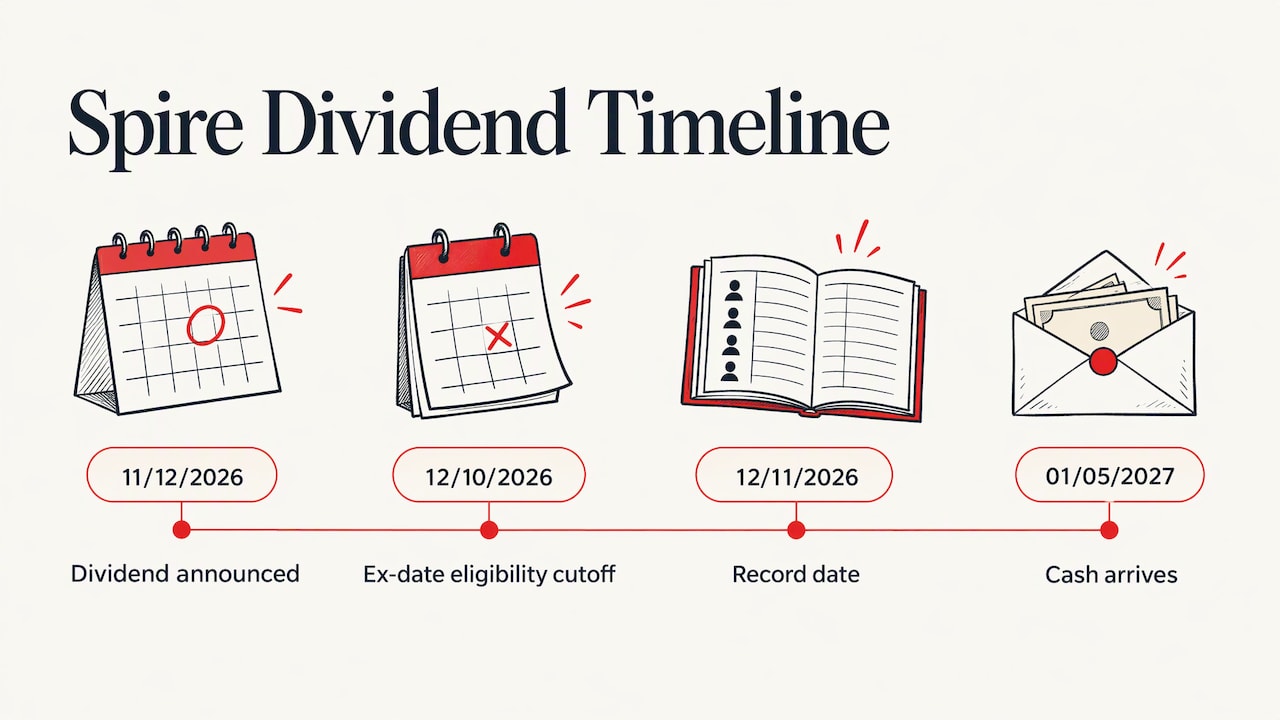
Spire Inc.'s dividend page lists its next quarterly dividend of $0.865 per share: announced 11/12/2026, ex-dividend 12/10/2026, record date 12/11/2026, payable 01/05/2027. Notice the pattern. Anyone who owns the stock before December 10 qualifies, yet the cash arrives almost a month after the record date. Your calendar needs both the ex-date (to know whether you are eligible) and the pay date (to know when to expect cash).
Build a payout calendar you can trust
A payout calendar turns scattered announcements into a month-by-month view of expected income. Here is the routine.
- List every holding with its payment frequency. Mintos’ help center notes that most companies pay quarterly, many U.S. companies pay every quarter, many European companies pay once or twice a year, and a few pay monthly. Mixed holdings mean uneven months, which is exactly what a calendar reveals.
- Pull dates and amounts from the source. Company investor-relations pages, like Spire’s above, publish the declared amount, the ex-date, record date and pay date, plus the history of earlier payments.
- Mark special dividends separately. One-off payments are announced in advance, according to Mintos. Do not fold them into your regular run rate, or your forecast will look better than it is.
- Check each deposit against the calendar. Dividends are credited after withholding tax where it applies, so the amount in your account can be smaller than the declared figure times your shares. Note which payments came in net.
- Update after every announcement. A raise, a cut or a date change should flow into your forecast the same week.
The weak spot in this routine is step 5. Calendars built by hand go stale quickly once you hold 20 or 30 payers. Chicken Analytics includes payout calendars and income forecasting in its dividend portfolio tracker, so the schedule and the projected cash flow sit together. You can see the full list on the features page.
Cash or reinvest? Decide per holding
Every payment gets one of two jobs: land as cash, or buy more shares. A dividend reinvestment plan (DRIP) does the second automatically. Neither is right for everything, so decide by goal.
Take cash when:
- You are drawing income now, for bills or retirement spending.
- One position has grown too large and you want to send new money to a smaller holding instead of adding to the big one.
- You are building a cash buffer before the next buy.
Reinvest when:
- You are still in the growth phase and want each payout to buy more shares that pay more dividends next quarter.
- The company is one you already want more of, at a weight you are happy with.
- You like the discipline of putting every payout to work without a decision each time.
A useful middle path is to reinvest in your core, steady payers and take cash from the rest, then redirect that cash to whichever holding is furthest below its target weight. Our guide to diversifying a dividend portfolio covers sector limits and rebalancing in detail.
The real question is what reinvestment does over years. Chicken Analytics includes a DRIP calculator, so you can simulate reinvestment scenarios and see projected passive income, yield on cost and compounding returns before you flip the switch on any holding. Run the numbers both ways and let the chart make the call.
Forecast the income you will actually get
A forecast starts with simple math: shares owned times the declared per-share dividend, times the number of payments per year. If you hold 200 shares of a company paying $0.75 per quarter, that is $150 per quarter, or $600 per year, before any withholding or taxes.
Then make it realistic with three adjustments.
Add growth
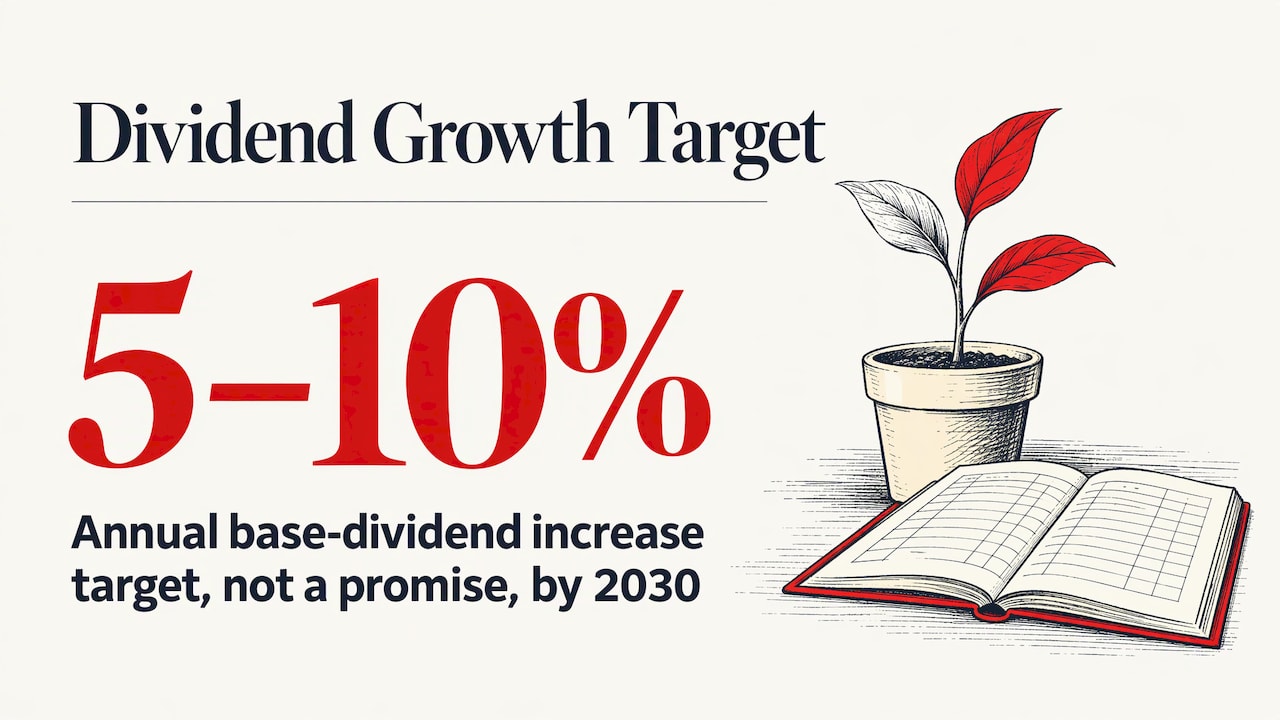
Many dividend growth companies state a policy. OMV Petrom, for example, says its dividend policy targets raising the base dividend per share by 5 to 10 percent a year by 2030. A stated target is a plan, not a promise, so model growth in a base case and a cautious case rather than one hopeful line. Tracking your dividend growth rate over time shows which holdings are the fastest growing birds in your flock.
Respect the fine print
Companies say plainly that payouts can change. Annaly Capital’s dividend page lists a $0.75 quarterly dividend and notes there is no guarantee the same or a similar level will be paid in the future. Build a column in your forecast for each holding’s payout ratio, the share of earnings paid out as dividends, and watch it. Our article on dividend safety explains how to read it.
Check concentration
If one sector pays a third of your income, one bad year there can dent your whole forecast. Sector allocation alerts in Chicken Analytics flag it when your nest is getting too heavy on one side. For a target such as living on dividends, the planning steps are in our guide to living off dividends.
Keep records that match your tax forms
Every dividend you receive in a U.S. taxable account becomes a line on your tax return, so records pay for themselves in April.
- Keep a running list of income sources and amounts. IRS Publication 550 tells investors to keep a record of the sources and amounts of investment income received during the year, along with the forms showing it, such as Form 1099-DIV.
- Know where dividends go. The same publication directs qualified dividends to Form 1040 line 3a and ordinary dividends to line 3b.
- Use the 1099-DIV as the final number. Natixis Funds’ 2025 tax notice states that if a year-end statement and the 1099-DIV differ because of reclassification after year-end, the 1099-DIV amount is the one to use. It also says a fund sends a 1099-DIV only when taxable distributions total $10 or more, so small payers may not generate a form.
- Watch your holding period. Under the IRS instructions for Form 1099-DIV, a dividend does not count as qualified if you held the share less than 61 days during the 121-day period that begins 60 days before the ex-dividend date. That ties your tax treatment straight back to the ex-date you tracked on your calendar.
If you want a second pair of eyes on investment income when you file, a personal tax return preparation service can go through your forms with you and explain the return line by line. For questions about your own situation, a tax professional is the right person to ask.
Measure how your payouts are performing
A dividend check is only half the picture. Two numbers keep you honest:
- Yield on cost: your annual dividend divided by what you originally paid. It rises as companies raise payouts and as reinvestment adds shares, and it shows the reward for patience.
- Total return: dividends plus price change. Our walkthrough on calculating portfolio rate of return shows it step by step.
Before adding a new payer, run it through the checks in analyzing dividend stocks. Browsing the instrument directory also shows dividend histories for individual securities.
A monthly routine that takes about 20 minutes
- Open your payout calendar and tick off every deposit that arrived. Note anything late or short.
- Check announcements: raises, cuts, new dates. Update the forecast.
- Decide where this month’s cash goes: reinvest, rebalance or reserve.
- Glance at your health alerts and sector weights.
- Save any new tax forms or broker statements to one folder.
That is the whole system. The habit matters more than the tool, though the right tool makes the habit stick.
Perspective: why a dividend portfolio deserves its own tracker
We built Chicken Analytics around one idea: a dividend investor’s real scoreboard is income, not the daily price.
Most platforms show you value first and payouts as an afterthought. We flip that. When you open your portfolio, we want you to see projected cash flow, how fast each payout is growing, and which birds in the flock need attention. Our alerts are designed to flag the health of individual stocks and the balance of your sectors, so you can act before a surprise lands in your account.
Managing dividends well is mostly about seeing the whole picture at once: the calendar, the forecast, the reinvestment plan and the yield on cost. We simplify those metrics so novice and experienced investors can feather their nest with confidence.
Count your chickens, but do it with a calendar.
Fabio
Put your dividend calendar on autopilot
Chicken Analytics is a portfolio tracker made for dividend growth investors. It brings payout calendars, income forecasting, dividend growth analysis, stock health alerts, sector allocation alerts and a DRIP calculator into one view. Pricing is published on our site: 0.01% per year of assets under management, with a minimum charge of $0.50 per month. See the details on the pricing page, or start from the Chicken Analytics home page.

FAQ
How do I know when I will receive a dividend?
Check the company’s investor-relations page for the payment date, which is listed alongside the declared amount. You qualify if you own the shares before the ex-dividend date, and the cash typically arrives days to weeks after the record date. A payout calendar collects these dates for all your holdings.
Does buying on the ex-dividend date get me the dividend?
No. According to Investor.gov, buying on or after the ex-date means the seller receives the upcoming dividend. Buy before the ex-date to qualify.
Should I reinvest dividends or take them as cash?
Reinvest when you are growing your portfolio and want compounding to work for you. Take cash when you need income or want to steer money to an underweight holding. Many investors mix both by holding.
Why is my deposit smaller than the declared dividend?
Withholding tax can be taken before the cash is credited, as Mintos explains in its dividend overview. Compare the net deposit with the declared per-share amount times your shares, and record the difference.
Which tax form reports my dividends?
In the U.S., your broker or fund sends Form 1099-DIV. Qualified dividends go to line 3a of Form 1040 and ordinary dividends to line 3b, per IRS Publication 550.
Sources
- Investor.gov: Ex-Dividend Dates
- FTSE Russell: Global Equity Corporate Actions Methodology
- Mintos Help Center: How do stock dividends work?
- Spire Inc.: Dividends
- OMV Petrom: Dividends
- Annaly Capital: Dividends
- IRS: 2025 Publication 550
- IRS: Instructions for Form 1099-DIV
- Natixis Funds: Tax Information Notice 2025